

A CDL Driver’s Struggle: When the System Fails to Update a Valid Medical Certification
A System Glitch That Put a Career on Hold
For professional truck driver Jesse Wayne Shelander, one unchecked box nearly ended his ability to work.
Despite following every rule and maintaining full compliance with federal and state requirements, his Commercial Driver’s License (CDL) was unexpectedly downgraded, not because of anything he did wrong, but because of a technical error buried deep within a federal database.
“I did everything by the book,” Shelander said. “I went to my medical examiner, passed my exam, got my paperwork, and somehow the system still failed me.”
Background: A Fully Compliant Driver
Shelander, a Class A CDL driver, has always stayed current with the Federal Motor Carrier Safety Administration (FMCSA) and Texas Department of Public Safety (DPS) regulations.
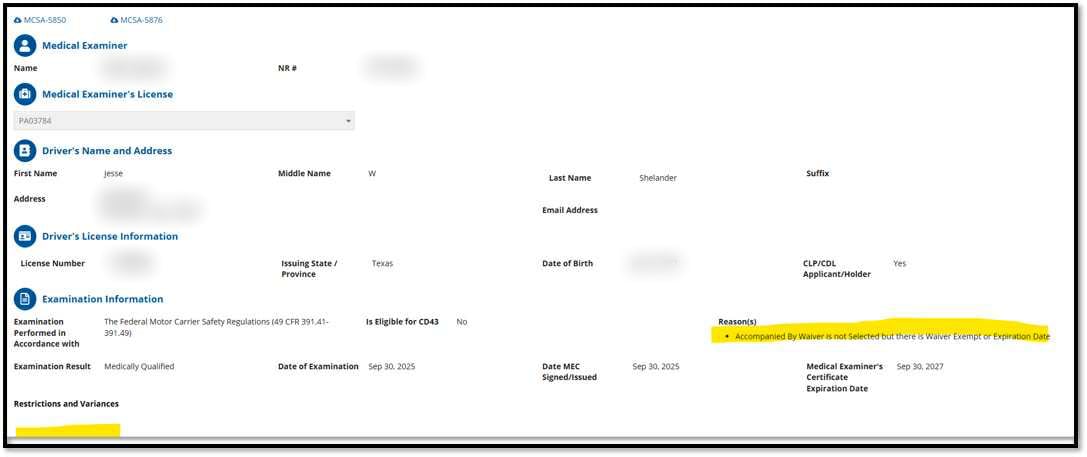
On September 30, 2025, he completed his regular DOT physical exam with his Certified Medical Examiner (CME). His Medical Examiner’s Certificate (MEC) was renewed through September 30, 2027.
Under federal law, medical examiners must submit both a paper copy and an electronic version of the results to FMCSA’s National Registry of Certified Medical Examiners (NRCME) so that state licensing agencies, like Texas DPS, can automatically update drivers’ records.
According to Shelander’s medical examiner’s office, that electronic submission was completed the same day.
But within days, he learned his CDL had been downgraded, showing his medical certification as “not current” in the DPS database.
The Discovery: A Missing Mark in the National Registry
After countless calls and emails between FMCSA, DPS, and his medical examiner, the real cause came to light:
Although Shelander’s paper certificate correctly indicated that he requires a hearing exemption, the electronic submission sent by his medical examiner did not mark that box.
That single missing checkmark caused FMCSA’s National Registry system to reject the data, preventing his updated medical certification and exemption from transferring to the state.
FMCSA Confirms: An Electronic Submission Error
After several weeks of confusion, FMCSA confirmed that the problem was not with Shelander or the state, but with a data entry error made during the submission process.
“Although your medical certificate indicates that a hearing exemption is required, the corresponding electronic submission from your medical examiner to the National Registry database did not reflect this requirement,” FMCSA wrote.
“As a result, your medical certification was not successfully transferred to the Texas State Driver’s Licensing Agency.”
The Impact: A Driver Out of Work
Because of that discrepancy, Texas DPS could not verify his medical status, and Shelander’s CDL was automatically downgraded. Despite holding valid paperwork, he was now legally barred from operating a commercial vehicle.
Under National Registry II, which took effect June 23, 2025, states no longer accept paper copies of medical certificates. All updates must flow electronically from FMCSA’s database to each state’s system.
That means a driver can hold a valid paper certificate, yet still be marked as non-compliant if the electronic record fails to transmit correctly.
“It’s crazy,” Shelander said. “Everything on paper says I’m cleared to drive. But because of one unchecked box, the computer says otherwise, and the computer wins.”
FMCSA’s Directive to the Medical Examiner
FMCSA contacted Shelander’s medical examiner directly, explaining what needed to be done:
“The driver has been placed out of work because, although his paper Medical Examiner’s Certificate correctly indicates that a hearing exemption is required, your electronic submission to the National Registry did not include this information. Please resubmit the results, marking that he requires a hearing exemption. The updated submission should reflect the same information as the original medical examination.”
In other words, the medical examiner must re-enter and resubmit the record with the correct exemption marked. Once corrected, the system will automatically send the update to the state, restoring Shelander’s medical compliance status.
Still Waiting: Frustration Builds
Despite FMCSA’s clarification, Shelander says his CDL remains downgraded, leaving him unable to return to work.
“I’ve done my part. FMCSA has done theirs. But the process to fix it is painfully slow,” he said. “Meanwhile, I can’t drive, can’t earn a paycheck, all because of a clerical error I had nothing to do with.”
This ordeal underscores a major flaw in the new electronic system: a single human error by a medical examiner can cause a cascade of consequences for drivers who depend on their license for their livelihood.
A Call for Accountability and Reform
Shelander believes his experience should serve as a wake-up call for both FMCSA and state licensing agencies.
“Drivers shouldn’t lose their income because of data-entry mistakes,” he said. “There needs to be accountability and a faster way to correct errors like this.”
Experts and advocates agree that the FMCSA system needs stronger safeguards, including:
- Automatic cross-checking between paper and electronic records to detect mismatches.
- Mandatory CME training focused on electronic submission procedures.
- Faster appeals and correction channels for drivers affected by submission errors.
Without such improvements, compliant and responsible drivers may continue to face unnecessary job interruptions due to minor administrative oversights.
A Warning to All CDL Holders
Shelander’s experience highlights an important message for all CDL drivers, especially those who hold federal medical exemptions for hearing, vision, or other conditions.
Before leaving the clinic, drivers should:
- Verify that all exemption boxes are correctly checked on their paper certificate.
- Ask the medical examiner to confirm that the same data was entered electronically into the FMCSA National Registry.
- Follow up with their state licensing agency to ensure the update has been received.
A single unchecked box should never sideline a professional driver. But as Shelander’s story shows, in today’s digital system, it can, and it did.
Conclusion: The Cost of a Clerical Error
What happened to Jesse Wayne Shelander is more than an individual oversight, it’s a systemic failure. A system designed to ensure safety and compliance ended up punishing a driver who followed every rule.
His case is a reminder that even in a highly regulated industry, technology is only as reliable as the people who use it.
Until processes improve, drivers like Shelander remain at risk of losing their livelihoods not because of safety violations or misconduct, but because of errors hidden behind a computer screen.
“A small mistake in a federal database shouldn’t take away a person’s career,” Shelander said. “But right now, that’s exactly what’s happening.”
Interview conducted with: Jesse Shelander
Research and written by: Kerri Wright
Prepared, finalized, and officially submitted to the FMCSA representative for review and presented to the Roundtable by the Deaf Truckers United (DTU) Administrative Team.
Content Notice:
This article reflects official communications and submissions by Deaf Truckers United (DTU) and has already been submitted to the Federal Motor Carrier Safety Administration (FMCSA). This content is shared for member awareness and transparency.
Unauthorized copying, reposting, or submission of this material (in whole or in part) as original work is discouraged.